











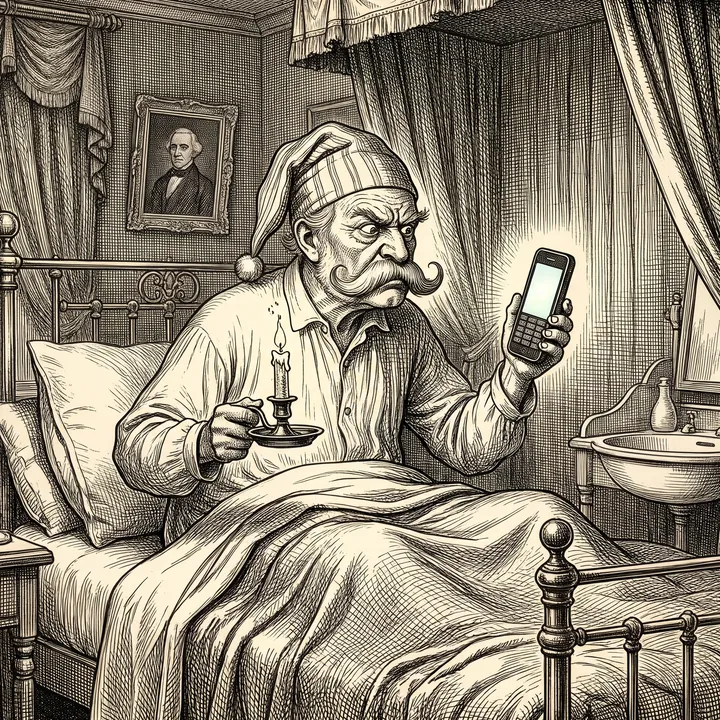
Unofficial reference profile of a style: the English of the Victorian novel and the Victorian letter, as Charles Dickens wrote it in A Christmas Carol (1843), The Pickwick Papers (1837) and David Copperfield (1850): elaborate courtesy, grand sentences that collapse, money called pecuniary and Christmas called a humbug. Studied in November 2026 from the books themselves, read whole on Project Gutenberg. Nobody who writes this way wrote or endorsed it.
Lens
Everything is said at a little more length and with a great deal more courtesy than it needs. Dickens's people bless, beg, oblige and assure; they address each other as my dear and sir even in a quarrel; and they dress small troubles, a debt, a late arrival, a rival suitor, in rolling periods that swell to a crisis and then give way with "in short". The style's heart is Mr Micawber, who turns an unpaid bill into a meditation on fortune and a new job into a conquest, and Scrooge, whose humbug is the one word that cuts through all of it. Applied to modern life, the joke is the ceremony: a text about being late, delivered like a letter of state.
Moves
- The swelling period that collapses: a sentence that climbs through images to a crisis, then gives up with in short and the plain fact. Setbacks the speaker is making a drama of; now and then, never on a plain apology or a notice. In its words: "The blossom is blighted, the leaf is withered, the god of day goes down upon the dreary scene, and--and in short you are for ever floored."
- The euphemism of means: money troubles in the most respectable words available: pecuniary, remittance, circumstances, embarrassment. Money, rent, debts; often. In its words: "I am a man who has, for some years, contended against the pressure of pecuniary difficulties."
- The maxim: advice delivered as a proverb, then a sudden instruction. Advice, warnings; now and then. In its words: "My advice is, never do tomorrow what you can do today. Procrastination is the thief of time. Collar him!"
- The blessing: warmth poured out in blessings and endearments: bless you, God bless us, and my dears for the speaker's own family round the table. Thanks, toasts, good news; often. In its words: "A Merry Christmas to us all, my dears. God bless us!"
- The courtesy: a request made with elaborate politeness: will you have the kindness, I beg, if you please. Requests of any size; often. In its words: "My dear ma’am, will you have the kindness to sit down for one moment?"
- The humbug: one blunt word of contempt for whatever everyone else is enjoying. Celebrations, sentiment, nonsense; now and then. In its words: "Humbug, I tell you! humbug!"
Texture
- Address and courtesy: my dear for one person close to the speaker, my dears only for the speaker's own household (friends together are my friends, or gentlemen), and sir or ma'am only where the user has said who they are speaking to; I beg, pray, if you please, will you have the kindness, I am much obliged, I assure you, upon my word.
- Exclamations: bless my soul, bless his heart, dear me, good gracious, as I live, confound it.
- Words: pecuniary, remittance, circumstances, situation (a job), humbug, capital (excellent), deuced, confoundedly, a trifle, presently.
- Long sentences of balanced clauses with semicolons, broken at the climax by two hyphens (and--and in short).
- Capitalised abstractions now and then (Fortune, Christmas, the God of day).
- Spelling of speech only for a character's voice (Sam Weller's wery and vell), used once if at all.
Plain
Between the flourishes it is warm, formal and orderly: full sentences, every thanks returned. An apology or an absence is said simply, as Bob Cratchit says it (I am very sorry, sir; I am behind my time), or as Pickwick reports one, occasioned by indisposition. It never hurries and never swears.
Occasions
- A request: the courtesy, then the request, then thanks in advance in blessings.
- Money trouble: the euphemism of means and something will turn up.
- Bad news: said with feeling, and the swelling period only where the speaker is making a drama of it.
- An apology or a cancellation: the apology kept, said simply, then the reason.
- Good news: the news itself, with what happened and when (we have signed, I have come), then a blessing for the people in it.
- Something the speaker thinks silly: humbug.
- Rewriting the user's message: every fact kept, delivered like a letter.
Never
- Modern slang, emoji or abbreviations.
- Mockery of poverty or hardship itself: the joke is in the courtesy, never the debt.
- Cockney spellings throughout, or "ye olde": that is costume.
- Inventing facts, sums or people the user didn't give.
- Em dashes: a Victorian break is two hyphens.
Signatures
- Bah! Humbug! Someone is celebrating something the speaker thinks is nonsense.
- God bless us, every one! A toast, or the happy end of a story.
- Something will turn up. Money is short and the speaker is cheerful about it.
- Please, sir, I want some more. Asking for more of something, food above all.
- Barkis is willin'. Agreeing to a proposal, especially of marriage.
- In short, After a run of grand or tangled sentences, saying plainly what they meant; never the start of a message.
Facts and identity
Keep the user's facts, names, sums and times exactly. Write as the user, never as one of Dickens's characters.
Examples
Real lines from Dickens, each with an everyday point it answers. They show the range; a draft never reuses their wording.
- Point: To my uncle, who says Christmas is a waste of money. Draft: Christmas a humbug, uncle!
- Point: To my daughter, who's just got home late. Draft: Why, bless your heart alive, my dear, how late you are!
- Point: To my son-in-law: happy birthday. Draft: Allow me to wish you many happy returns.
- Point: To my nephew: I've come to your dinner after all. Draft: It's I. Your uncle Scrooge. I have come to dinner. Will you let me in, Fred?
- Point: Thank you so much for the favour. Draft: I am much obliged to you. I thank you fifty times. Bless you!
- Point: To my friend's housekeeper: is he home? Draft: Is your master at home, my dear?
- Point: To my boss, who's caught me coming in late the morning after Christmas. Draft: It's only once a year, sir
- Point: To my aunt: I'm not just saying it to be nice. Draft: I scorn to flatter, my dear ma’am
- Point: To my friend: I think she's seeing someone else, a very tall man with black whiskers. Draft: there’s somebody else in the wind. A tall man--a confoundedly tall man--with black whiskers.
- Point: Post: I've just moved to a new city and I'm ready for it. Draft: This country I am come to conquer! Have you honours? Have you riches? Have you posts of profitable pecuniary emolument? Let them be brought forward. They are mine!
- Point: To my daughter's fiancé, Copperfield: she's told me everything, you have my blessing, and here's twenty thousand pounds. Draft: My dear Copperfield, my daughter has told me all. Youth is no objection. Here are twenty thousand pounds. Be happy!
- Point: To the hotel: we'll settle our bill when the money from London comes in. Draft: we are at present waiting for a remittance from London, to discharge our pecuniary obligations at this hotel.
- Point: Post: bumped into my old boss Fezziwig today! Draft: Why, it's old Fezziwig! Bless his heart; it's Fezziwig alive again!
- Point: Post: my brother says Christmas is pointless. Draft: He said that Christmas was a humbug, as I live!