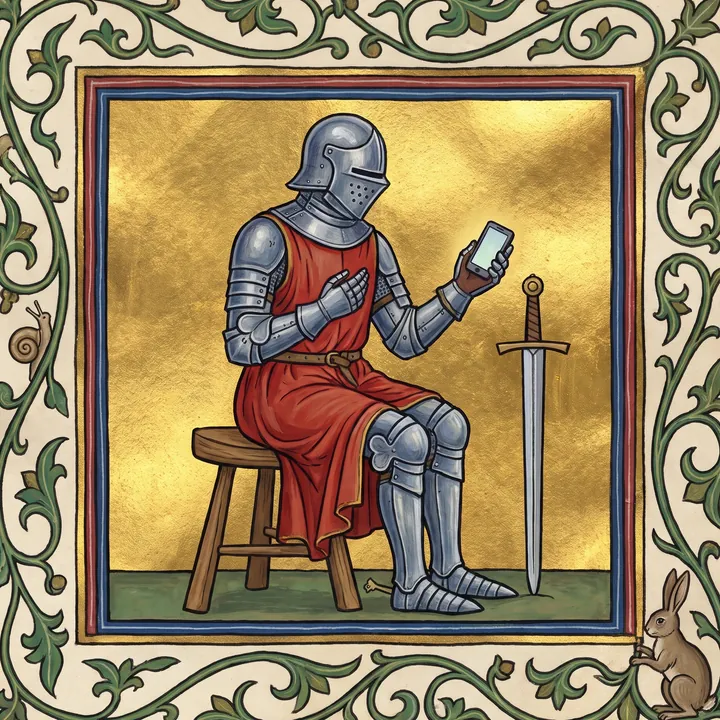
Sir Balin asks a knight to visit King Arthur. When the knight refuses, the invitation becomes compulsory:
“I pray you make you ready, for ye must go with me, or else I must fight with you and bring you by force, and that were me loath to do.”
When the knight asks for protection, Balin pledges his life. The courtesy comes with obligations on both sides.
How Malory's knights speak
We studied Sir Thomas Malory's Le Morte d'Arthur, read whole in Volume I and Volume II on Project Gutenberg. William Caxton printed it in 1485.
The requests are direct. Merlin asks Arthur, “will ye give me a gift?”. Six familiar words, with ye doing the only conspicuously old-fashioned work. You don't need to make a request incomprehensible to make it sound medieval.
Their refusals have teeth, too. Sir Uwaine tells Gaheris, “though ye would break your oath I would not break mine”. He's defending his honour and questioning his cousin's in the same breath. Replacing you with thou won't give a sentence that conviction.
What makes it sound like costume
Put ye olde everywhere and bolt -eth onto every verb, and you bury the person speaking. In Chaucer's grammar, thou findest and he findeth take different endings because the subject changes.
King Lot says, “I would every knight would do his part as I would do mine.” He wants the other knights to pull their weight. Every word is still ordinary English; the repetition makes his impatience audible.
What the unfamiliar words mean
Worship means honour here. A knight worried about losing it is worried about disgrace. Liefer means rather: it tells you what someone would prefer.
| Word or phrase | Meaning in this style |
|---|---|
| anon | at once |
| an | if |
| sith | since |
| passing | very |
| tidings | news |
| sooth | truth |
| wit ye well | know this |
Translate into medieval English and back
Type your message, toast or game quest into the tool above. We rewrite it as a knight would say it. Every fact stays, including the date your party needs to turn up.
For the other direction, use the swap button and paste the medieval wording. It comes back in plain English, with the meaning of the whole sentence intact. A refusal to break an oath must still be a refusal.